



Welcome to Tech Talents! In this newsletter, I share real-time key talent movements in the LatAm tech ecosystem, including founders entering and exiting stealth mode, executive-level movements in unicorns, and partner-level changes in local VC firms.
Here’s a quick look at what you’ll find in this week’s edition:
🎊 Startup Launches: mykel.ai, Human Edge AI
🤫 Talents Entering Stealth: Ex-Partner and People Ops at Stone Pagamentos, Ex-CRO at a Brazilian fintech & more
🦄 Unicorn Movements: New Chief Technology Officer at CloudWalk, Inc.
📖 Recent Reads: Open-Source AI Ban, The Odyssey Parallels & more
🤝 Tech Talents Match: Receba vagas em startups brasileiras que se encaixam no seu perfil, direto no seu WhatsApp. Acesse aqui.
Let’s dive in…
🎊 Startup Launches
Founders who have just publicly announced what they are working on.
mykel.ai
Overview
Startup Description: AI-native customer success platform that analyzes customer signals and executes next-best actions.
Industry: AI, SaaS, Marketing Tech
Team Size: 2
Time in Stealth: 1 month
Founder Profile
Fernando Carrasco – Co-founder at mykel.ai
Founder Highlights: Serial Founder, Technical Founder, Masters, Ex-Consultant
Signals: Repeat founder - ex-Co-founder & CTO of Inventa (Sao Paulo, raised USD 80M from a16z/Greylock, 2021-2026), ex-McKinsey Associate Partner, Columbia MBA.
Headquarters: São Paulo, Brazil
Ask for an Intro: Click here
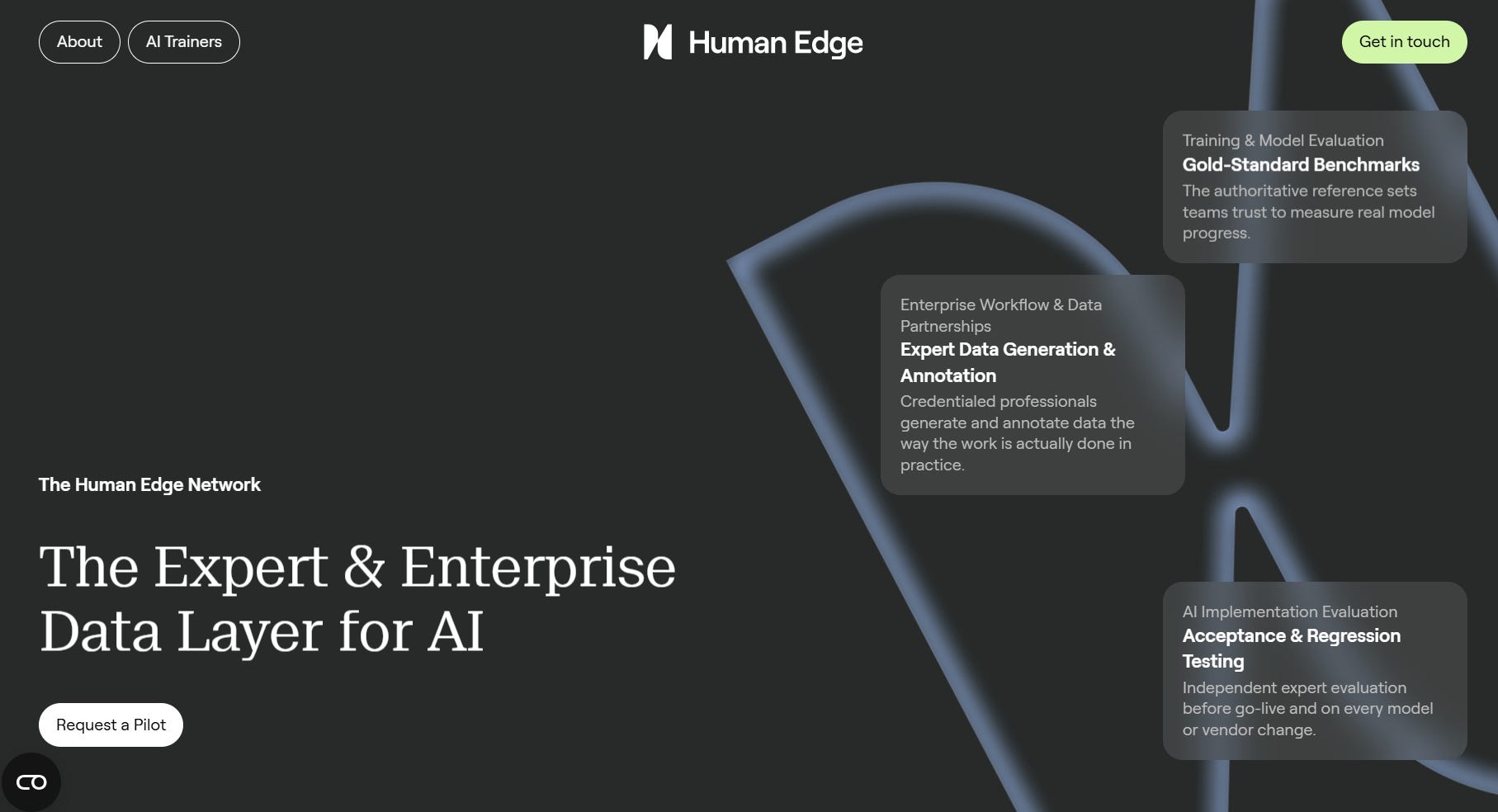
Human Edge AI
Overview
Startup Description: Governed expert-judgment system activating credentialed professionals to deliver structured, audit-ready datasets for AI post-training and evaluation.
Industry: AI
Team Size: 11
Time in Stealth: 1 year
Founder Profile
Carlos Andrés Aldana - Co-Founder at Human Edge AI
Founder Highlights: Serial Founder, Masters, Previous Exit, Top University, Ex-Corporate, Investor, Unicorn Experience, Scaleup Experience
Signals: Repeat founder with prior exit - ex-Co-Founder & CEO of Petsology (pet-care startup, 2019-2021), ex-Global General Manager of Quick Commerce - Turbo at Rappi (2022-2025), ex-Investment Professional at Mesoamerica, Wharton MBA.
Headquarters: Colombia
Ask for an Intro: Click here

🤫 Talents Entering Stealth
Talents with relevant experiences who have just entered stealth mode.
Livia Kuga – Co-founder at Stealth Startup
Founder Highlights: Masters, Top University, Doctorate, Ex-Corporate, Ex-Consultant
Signals: Co-founded a stealth venture nine months ago that is already backed by a16z speedrun and three other funds, after 8+ years scaling Stone’s people function from 80 to 15,000.
Headquarters: United States
Time in Current Position: 8 months
Ask for an Intro: Click here
+4 more Stealth Founders this week with Pro, including:
Ex-CRO at a Brazilian fintech who left in Sep 2025 and is four months into a new venture.
Repeat founder and two-time founder fellow, Stanford executive program, now on his third venture.
🦄 Unicorn Movements
Promotions, new hires, and other movements in local unicorns’ executive-level.
Yuri Gravatá – Chief Technology Officer at CloudWalk, Inc.
Previous Role: Director of Banking at CloudWalk, Inc.
Previous Experience: Ex-Head of Account, Pix and Digital Services at CloudWalk, Inc., ex-Technical Lead at CloudWalk, Inc., ex-Software Engineer at CloudWalk, Inc., Bachelor’s in Administration from PUC Rio de Janeiro.
Headquarters: Rio de Janeiro, Brazil
Time in Current Position: 1 month
📖 Recent Reads
My quick takes on interesting articles, news and data that I’ve come across recently.
Kimi K3, an open-source Chinese AI model, launched earlier this month. It performs close to the frontier closed-source models from Anthropic and OpenAI, and it has opened several fronts of discussion in the tech world.
The first, and most obvious, is how fast China is closing the gap with the US on model performance. What was recently framed as a six-month American lead now looks far narrower. Some analysts are already measuring it in weeks.
Second, Washington is considering a ban on Chinese open-source models, and Silicon Valley is split over it. The case for a ban is a security one: AI models ship with guardrails to stop bad actors from using them for cyber crime and similar, and guardrails on open-weight models are far easier to remove. In response, 25 tech companies, including NVIDIA, Microsoft and Meta, signed an open letter warning against “premature restrictions” on open models.
Third, there is the distillation issue. The White House accused Moonshot AI of distilling Anthropic’s Fable 5 to train Kimi K3, essentially claiming the Chinese lab stole Anthropic’s IP by training on millions of Claude responses.
I have a lot of thoughts on each of these, but here is the short version. I have no doubt China is catching up with the US on AI. Banning open-source models would backfire: startups drive much of the innovation in this space and depend on open weights for high-quality, low-cost AI. And distillation, to my mind, could actually work in the US’s favor. If Chinese labs keep building on frontier American models, that dependency makes it hard for them to ever take the lead.
Like many of you, I watched Christopher Nolan’s The Odyssey. Beyond the visual spectacle, I caught myself reading about the lessons a nearly 3,000-year-old story still has to teach, most notably the human urge to go home. The Greeks had a word for it: nostos.
For Odysseus, home was Penelope and Telemachus, his wife and son. But home can be anything you care deeply about: becoming a great founder or investor, making an impact, building relationships that last. And as the film makes clear, getting there is never easy. Odysseus faced a cyclops, giants, and storms, but also something subtler: seven years of comfort on Calypso’s island, where he was offered immortality if he would simply stop trying to leave. The monsters are the obvious threat. The comfortable detour is the one that cost him almost a decade.
So here’s my question to you: what is your home, and are you willing to face what it takes to get there?
As someone always looking for ways to grow my newsletter and product audiences, I found this NFX piece by James Currier on why people share quite interesting. It lays out 8 motivation clusters behind sharing, all grounded in human psychology. Among them: status (associating yourself with something exclusive, or being seen as in the know), identity projection (signaling who we are and what we stand for or against), and being helpful (passing along real utility to our tribe).
Just as useful is the flip side. Currier frames every share as an unconscious cost-benefit calculation: how will this make me look, and how much effort will it take? People hold back when the cost side wins. When there’s too much friction in the sharing itself, or when the risk of looking behind the curve outweighs whatever credit they’d get for passing it on.
If you have any feedback or suggestions about Tech Talents LatAm, please share them with me through my LinkedIn.