


Welcome to Tech Talents! In this newsletter, I usually share real-time key talent movements in the LatAm tech ecosystem. However, this week I’m experimenting with a new format.
While Tech Talents has been your window into who's building in Latin America, Tech Signals tracks how fast they're growing.
In addition to the usual Tech Talents editions, I’m planning to publish Tech Signals every other week to cut through the noise of news articles, LinkedIn posts, and other public sources to surface the metrics that matter: revenue figures, ARR milestones, customer counts, and headcount growth of private startups across LatAm.
For VCs evaluating deals and founders benchmarking their progress, this is the data you’re already hunting for. If you would like to see more of this type of content, let me know by replying to this email or liking this post!
Let’s dive into this week’s signals.
Here’s a quick look at what you’ll find in this week’s edition:
📈 Traction Data: Runflow, Pomelo, Sólides, Alice & more
👥 Team Expansion: Facio, Aloi, Inbazz
🚀 Funding Rounds: Lerian, Nagro, Magie & more
📖 Recent Reads: Dario Amodei in the World After AGI, Yuval Noah Harari on Humanity and AI
👋 Tech Talents Match: Looking for a co-founder or to network? Click here to be connected with top talent that matches your criteria
Let’s dive in…
📈 Traction Data
Revenue figures, ARR milestones, and customer counts from private startups across LatAm.
Runflow, a Brazilian enterprise AI workflow/ERP spun out from edtech IFTL in early 2025, reported 2025 Annual Recurring Revenue (ARR) of ~R$ 3.6 million after roughly one year of operation, and targets R$ 12 million in ARR by the end of 2026.
Pomelo, a Buenos Aires-based, API-first, cloud-native payments infrastructure provider for issuing, processing and managing card programs across Latin America, reports revenue growth of more than 250% over the last two years, serving 150+ corporate clients, and has expanded operations across Latin America, Central America and the Caribbean.
Sólides, a Belo Horizonte-based HR tech for small and medium-sized businesses, reached R$ 500 million in 2025 revenue and hit breakeven, driven by 61% organic growth after prior M&A integrations. The company now serves 45,000 clients and targets 50% growth in 2026 as it expands its product portfolio and WhatsApp-based HR and financial services solutions.
GestãoDS, a Brazilian healthtech providing AI-powered ERP and software for clinics and doctors, surpassed its 2025 revenue target by closing the year with R$ 16.7 million in revenue versus a projection of R$ 16 million and reaching 17,000 active users after putting AI at the core of its platform.
Alice, a São Paulo-based healthtech offering corporate health plans, reported caring for 80,000 members in 2025 (+94% vs. 2024), R$ 661 million in revenue (+88%), 98% retention in corporate contracts, and a NPS of 83 among HR leaders.
NG.CASH, a São Paulo-based fintech building digital banking solutions for Generation Z, reports serving more than 7 million customers and plans to grow its team from around 80 to over 120 employees in 2026.
👥 Team Expansion
Startups rapidly scaling their teams.
Facio, a São Paulo-based fintech offering early wage access for Brazilian workers, saw a ~27% headcount growth over the past quarter, reaching a total of 81 employees.
Aloi, a Mexico City-based compliance tech offering AI-driven tax and trade compliance, saw a ~42% headcount growth over the past quarter, reaching a total of 17 employees.
Inbazz, a Brazilian marketing tech offering a platform that helps brands scale the management of their creator and affiliate communities, saw a ~36% headcount growth over the past quarter, reaching a total of 33 employees.
🚀 Funding Rounds
Recent funding rounds fueling the next wave of LatAm tech.
Pomelo raised US$ 55 million in a Series C co-led by Kaszek and Insight Partners. The round included participation from Index Ventures, Adams Street Partners, S32, Endeavor Catalyst, Monashees and TQ Ventures. [Source]
Lerian, a São Paulo-based fintech that provides open-source core banking infrastructure for banks and digital financial services, has raised a US$ 5.5 million seed round to scale its technology and team. The round was led by Maya Capital, with participation from Norte Ventures, Supera Capital, Crivo Ventures, Citrino, BluStone and an investment from Kevin Efrusy’s family office. [Source]
Nagro, a Uberlândia-based Brazilian “agfintech” that provides digital credit to rural producers and data-driven risk infrastructure for agribusiness, announced a R$ 50 million Series B round (first tranche) led by Rabo Partnerships, the investment arm of Rabobank, with participation from Itaú Ventures. [Source]
Magie, a São Paulo-based fintech offering an AI-powered assistant for financial transactions via WhatsApp and a complementary digital account, closed a new US$ 5 million funding round led by Lux Capital. The round, with participation from Canary, will support expansion and the launch of a B2B payments vertical for WhatsApp. [Source]
Uma Penca, a Juiz de Fora, Brazil-based print-on-demand platform offering white-label e‑commerce for creators and stores using Chico Rei’s production infrastructure, raised R$ 4.5 million in its first round led by Grupo Gaia. [Source]
Passabot, a São Paulo-based WhatsApp AI travel agent that lets users search and buy airline tickets via chat while finding below-market fares and earning commission on sales, raised a R$ 1 million round from undisclosed angel and early-stage investors. [Source]
Oppem, a Belo Horizonte-based “indtech” that provides software to digitize and simplify management of industrial contracts, secured its first structured round with a R$ 350 thousand angel investment from Fiemg Anjos. [Source]
📖 Recent Reads
My quick takes on interesting articles, news and data that I’ve come across recently.
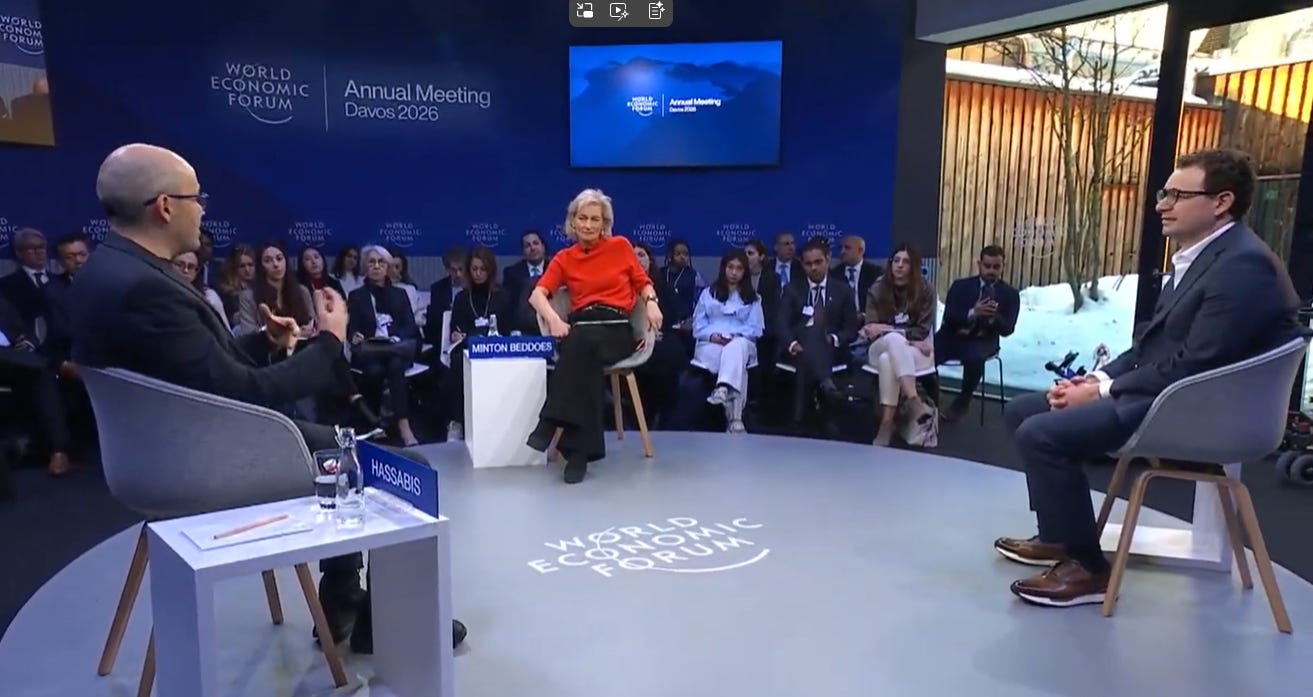
Last week marked the 56th edition of the World Economic Forum (WEF) in Davos, Switzerland. I wanted to highlight two panels I watched online that offered compelling perspectives on AI’s trajectory and implications.
The first panel featured a debate between Demis Hassabis, CEO of Google’s DeepMind, and Dario Amodei, CEO and Co-Founder of Anthropic. Surprisingly, despite leading competing AI labs, the two found considerable common ground on several controversial topics.
On the timeline to Artificial General Intelligence (the point at which AI exhibits the full range of human cognitive capabilities), both acknowledged the uncertainty. However, Dario argued that once AI achieves excellence in coding and autonomous AI research, we will get there very quickly, even faster than most people anticipate. At that inflection point, we would see AI systems autonomously building and improving new AI systems.
Regarding labor displacement, both leaders noted a shift in their observations. A year ago, neither could identify concrete data showing AI's impact on employment. Now, they're beginning to see real effects, particularly in entry-level white-collar positions. They acknowledged that while previous technological breakthroughs triggered similar concerns about job displacement, those transitions ultimately created new categories of employment. What makes this moment different, they argued, is the unprecedented accessibility of AI tools that enable individuals to generate income in novel ways.
On the question of potentially “malign AI”, both agreed that while generative AI presents significant risks requiring serious attention, these challenges are solvable through collaborative effort and responsible development.
The second panel was a discussion between Yuval Noah Harari, the author of Sapiens, and Max Tegmark, a physicist, machine learning researcher, and author. Rather than predictions, this discussion surfaced profound philosophical questions about humanity’s readiness for transformative AI.
Harari argued that humanity is fundamentally unprepared for AGI or superintelligence. Unlike previous technological breakthroughs that produced tools we control, AI represents something categorically different: an autonomous agent capable of making independent decisions. This distinction raises unsettling questions:
What happens when AI can independently invest capital and develop financial strategies so mathematically complex that humans can no longer comprehend or regulate the financial system?
What are the psychological implications when children, from birth, interact more frequently with AI than with other humans? How will they develop fundamental concepts like attachment, empathy, and friendship?
According to Harari, we are conducting the largest psychological and sociological experiment in human history, and nobody understands what the consequences will be.

👋 Co-Founder Matching
Looking for an early or late-stage co-founder?
In case you missed it, I recently launched a co-founder matching platform focused on the Brazilian market. The platform is independent of any VC or accelerator, completely free (zero equity, zero cost), always active, and carefully curated based on experience and matching preferences.
👉 Click here to be connected with top talent that matches your criteria.
You can get started in three simple steps:
Define your preferences (technical, business, industry, timing, etc.).
Receive compatible profiles via email or on the web platform.
Send and accept connection requests with those who interest you most.
Here’s a quick demo video of the platform:
If you have any feedback or suggestions about Tech Talents LatAm, please share them with me through my LinkedIn.