


Welcome to Tech Talents! This is a special edition that steps away from our usual LatAm talent movements. We’ll be back to the regular format next issue.
Clique aqui para ler em português.
One of my first tasks when I started to work in venture capital seven years ago was to help improve our investment memo framework. We were a small team setting the strategy for our next fund, and establishing structured processes was a core priority. Within the investment team, the memo was central to the overall investment process.
While the partners brought their experience and feedback to shape its foundations, I tried to complement this by researching how the best firms in the industry approached the task. So, I started looking for public investment memos from legendary VCs like Sequoia and Bessemer. To my surprise, quite a few were available.
So let’s look at two of these publicly available memos and highlight a few interesting sections in each of them…
Investment Memos, Explained
Investment memos are documents (either written or in slide format) that present the most relevant information for making an investment decision in a startup. They typically cover the problem the startup is addressing, the potential size of the opportunity, the solution being developed, team bios, and other key information. In some way, every critical aspect of the business is touched upon.
These memos are usually prepared by the partner at the VC firm who is sponsoring/advocating for the deal, with support from analysts. The memo is then shared with the rest of the partners prior to the investment committee meeting, where the final decision is made.
Because investment memos often contain confidential information, both about the startup under evaluation and the VC firm’s internal methodology, they are generally not shared outside the firm. However, some VCs have published their original memos, or redacted versions, either for older investments or due to legal requirements. For us tech enthusiasts, these shared memos are a gold mine of insights.
Sequoia Capital’s YouTube Memo

This is probably the most interesting public memo out there. Since it was part of a lawsuit, Sequoia was required to publicly release the full memo exactly as it was originally written—without any modifications. That alone makes it unique compared to most of the other memos we see online. But what makes it even more interesting is that it involves a company that went on to become a massive success, acquired by Google for over a billion dollars. It gives us a rare insider view into how one of the most reputable VCs in the world makes investment decisions.
Here’s what caught my attention:
Early-stage VC bets are high conviction plays full of uncertainty.

When the memo was written in September 2005, YouTube was only two months old. It had no CEO, no business plan, and plenty of risks spelled out in the document. And yet, with just a couple of months of limited data, Sequoia made a $5M offer (in two tranches) only three weeks after meeting the founders. That was a substantial commitment at the time.
Market trends and team as the key drivers.

So, what gave Sequoia the confidence to invest? The memo highlights several major trends YouTube was poised to ride: the rise of cell phones with video recording capability, home internet reaching critical mass, and the surge of user-generated content. On top of that, YouTube’s founders were three highly talented early PayPal employees, one of the hottest tech companies back then, which gave Sequoia even more conviction.
VCs tend to underestimate outliers’ success. And yet, we rely on them.
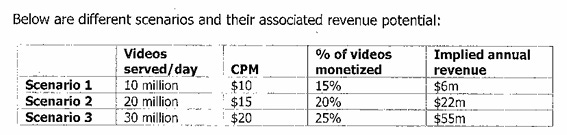
Sequoia’s memo suggested that serving 10–30 million videos a day might be overly optimistic. But less than a year later, YouTube was already delivering 100 million daily views, more than triple their most bullish projection (today, that number is around 5 billion views per day). And in some ways, it’s fortunate that VCs underestimate future success: the industry is built on a handful of outliers generating the bulk of returns, while most investments return little or nothing (the famous power law).
Purpose and vision as the north star.

The very first paragraph of the memo contains YouTube’s purpose — and that’s no accident. A compelling, shared vision is what aligns entrepreneurs and investors and what ultimately guides the company forward. While much has changed at YouTube since 2005, their purpose (the “why” behind their existence) has remained constant.
Bessemer Venture Partners’ Toast Memo

The second memo I wanted to bring up is Bessemer Venture Partners’ write-up on their Series B investment in Toast. For context, Toast is a now public company that offers a restaurant point-of-sale (POS) and management platform that helps restaurants improve operations, increase sales, and deliver a better guest experience—similar to Brazil’s “maquininhas”, but with a full suite of restaurant management software built in.
This memo covers the company’s first institutional financing, which was a sizable Series B, after more than five years of operations. Unlike the YouTube memo, there was far more real data for investors to analyze, and the company is a B2B business. Here are a few points that stood out:
Over a year of relationship before investing.
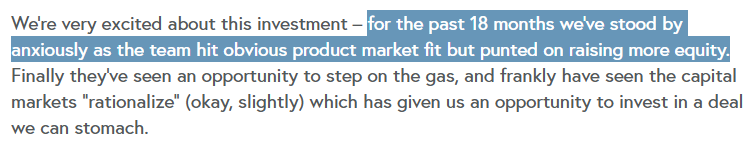
Bessemer’s partners engaged with Toast for 18 months before investing. It’s a great reminder that investors “invest in lines, not dots.” In other words, we like to meet founders early, track progress, and support them along the way before formally joining forces. This creates a win-win for both sides and meaningfully increases the odds of a healthy partnership.
Probability-weighted outcome modeling.
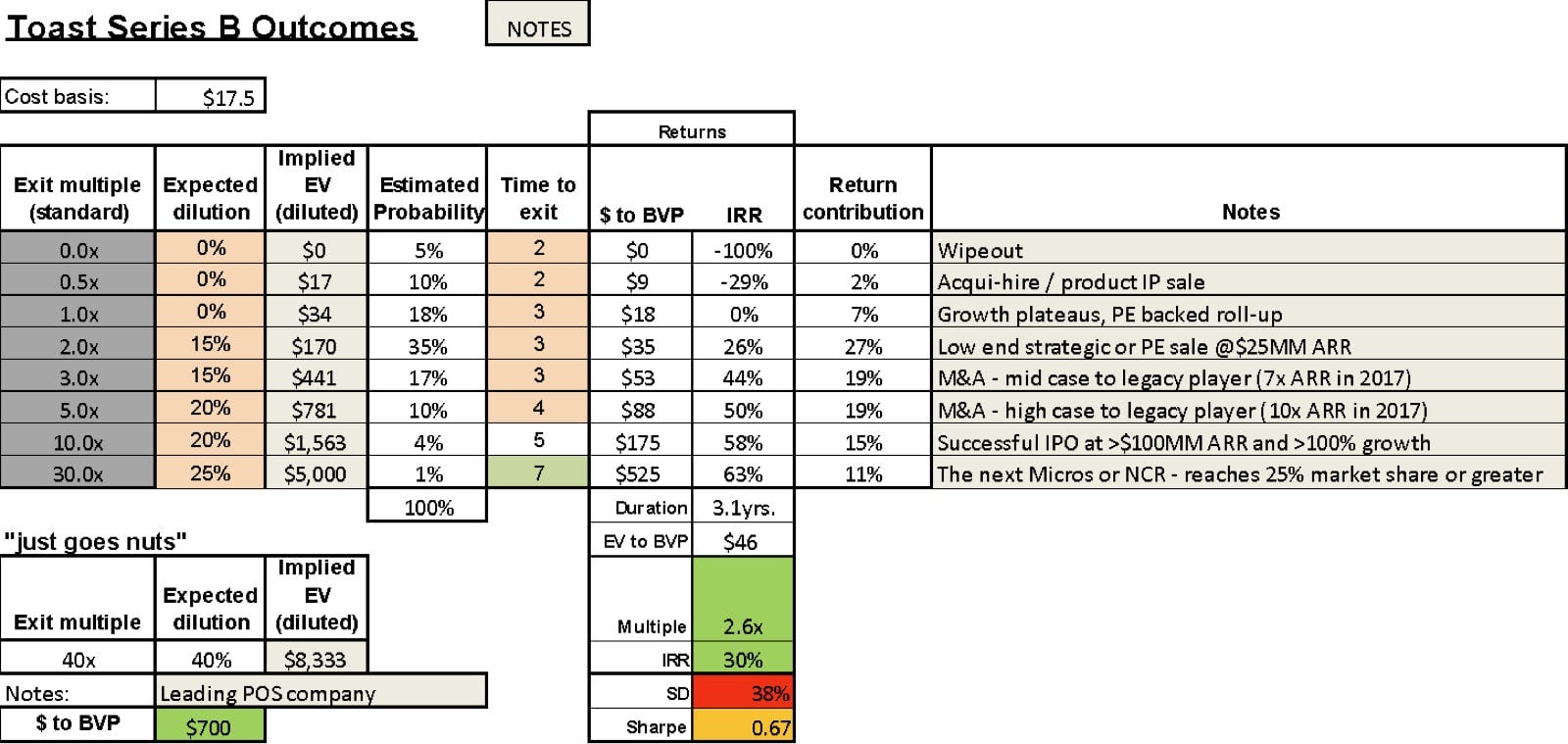
I could dedicate an entire post to quantitative methods VCs use to value startups, but the memo provides a strong example: modeling a range of future outcomes, from a total wipeout (0x) to a big win (30x). To counter the tendency to underestimate outlier success, Bessemer includes a “just goes nuts” scenario in which Toast becomes the leading POS company — an interesting and useful addition.
Customer references really matter.
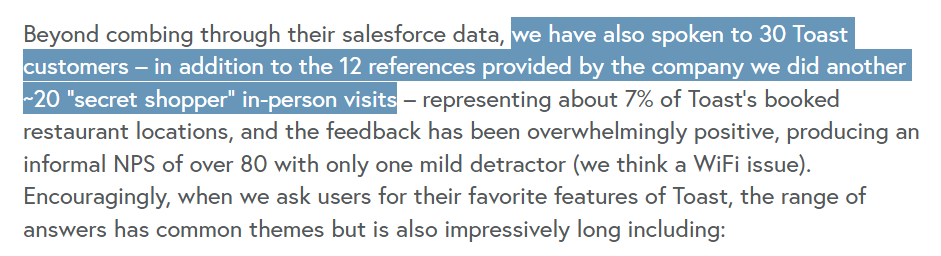
Bessemer spoke with more than 60 Toast customers during diligence. This shows how much VCs value customer conversations to validate whether the product truly delivers the impact founders claim and how mission-critical it is. Unannounced (“secret”) visits can be even more informative, since they elicit less biased feedback.
Heavy focus on metrics for later-stage deals.
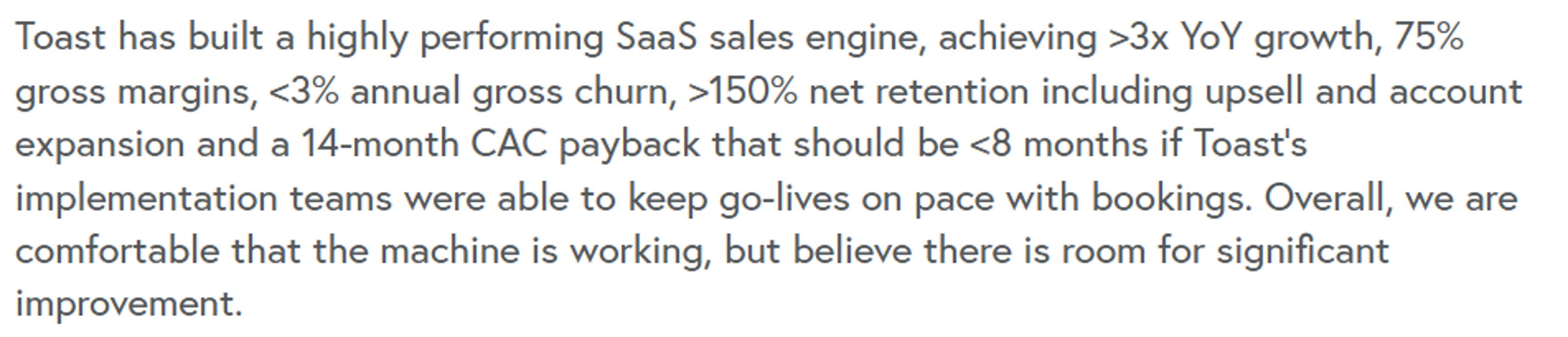
Later-stage diligence differs from early-stage largely because there’s more quantitative data. In the memo’s “Financials” section, Bessemer dives into core SaaS metrics, including gross churn, net retention, CAC payback, and more. The goal isn’t just to benchmark against the market but also to understand the business drivers and where there’s room to improve.
Memos are a core part of VC investing. For investors, they help structure thinking, reduce the risk of missing critical information, and educate the partnership ahead of the investment committee. For founders, they offer a rare glimpse into how VCs actually evaluate companies. I wish (and hope) more investors would share memos from long-past investments.
[PT-BR]
Uma das minhas primeiras tarefas quando comecei a trabalhar em venture capital, há sete anos, foi ajudar a melhorar nosso framework de memos de investimento. Éramos uma equipe pequena definindo a estratégia para o próximo fundo, e estabelecer processos estruturados era uma prioridade central. Dentro do time de investimentos, o memo era peça central do processo de decisão.
Enquanto os sócios traziam sua experiência e feedback para moldar a base, procurei complementar isso pesquisando como as melhores firmas do setor abordavam a tarefa. Então, comecei a buscar memos de investimento públicos de VCs lendários como a Sequoia e a Bessemer. Para minha surpresa, haviam alguns disponíveis.
Vamos então olhar dois desses memos públicos e destacar alguns trechos interessantes de cada um…
Memos de investimento, explicados
Memos de investimento são documentos (em texto ou apresentação) que reúnem as informações mais relevantes para a tomada de decisão de investimento em uma startup. Normalmente cobrem o problema que a startup resolve, o tamanho potencial da oportunidade, a solução em desenvolvimento, perfis do time e outras informações-chave. De alguma forma, todo aspecto crítico do negócio é abordado.
Geralmente, esses memos são preparados pelo sócio da firma de VC que está defendendo o investimento, com apoio de analistas. O memo é então compartilhado com os demais sócios antes da reunião do comitê de investimentos, onde a decisão final é tomada.
Como os memos de investimento costumam conter informações confidenciais, tanto sobre a startup avaliada quanto sobre a metodologia interna da firma de VC, eles normalmente não são compartilhados fora da firma. No entanto, alguns VCs publicaram seus memos originais, ou versões editadas, seja por serem investimentos antigos, seja por exigências legais. Para nós, entusiastas de tecnologia, esses memos públicos são uma verdadeira mina de ouro de insights.
O memo da Sequoia Capital sobre o YouTube

Provavelmente este é o memo público mais interessante que existe. Por ter sido parte de um processo judicial, a Sequoia foi obrigada a publicar o documento exatamente como foi escrito originalmente — sem nenhuma modificação. Isso por si só o torna único, em comparação com a maioria dos memos disponíveis online. E fica ainda mais interessante por se tratar de uma empresa que se tornou um enorme sucesso, adquirida pelo Google por mais de um bilhão de dólares. É uma rara visão de bastidores de como uma das firmas de VC mais respeitadas do mundo toma decisões de investimento.
Aqui está o que me chamou a atenção:
Apostas em estágio inicial são decisões de alta convicção cheias de incerteza.
Quando o memo foi escrito, em setembro de 2005, o YouTube tinha apenas dois meses de vida. Não tinha CEO, não tinha plano de negócios e havia muitos riscos listados no documento. Mesmo assim, com apenas alguns meses de dados limitados, o Sequoia fez uma oferta de US$ 5 milhões (em duas tranches) apenas três semanas depois de conhecer os fundadores. Para a época, era um compromisso significativo.
Tendências de mercado e time como foco.
Então, o que deu confiança à Sequoia para investir? O memo destaca várias grandes tendências que o YouTube surfaria: a popularização de celulares com câmeras de vídeo, a internet residencial atingindo massa crítica e a explosão do conteúdo gerado por usuários. Além disso, os fundadores eram três profissionais de alto nível vindos do PayPal, uma das empresas tech mais quentes da época.
VCs tendem a subestimar o sucesso dos outliers. E, ainda assim, dependemos deles.
O memo da Sequoia sugeria que atender 10–30 milhões de vídeos por dia poderia ser otimista demais. Menos de um ano depois, o YouTube já entregava 100 milhões de visualizações diárias — mais de três vezes a projeção mais bullish (hoje esse número gira em torno de 5 bilhões por dia). E, de certo modo, é bom que os VCs subestimem o sucesso futuro: a indústria é sustentada por um alguns poucos outliers que geram a maior parte dos retornos, enquanto a maioria dos investimentos retorna pouco ou nada (a famosa power law).
Propósito e visão como o norte.
O primeiro parágrafo do memo traz o propósito do YouTube — e isso não é por acaso. Um “porquê” claro e compartilhado é o que alinha empreendedores e investidores e, no fim, guia a empresa. Embora muita coisa tenha mudado no YouTube desde 2005, seu propósito (o “porquê” da sua existência) permaneceu constante.
O memo da Bessemer Venture Partners sobre a Toast
O segundo memo que quero trazer é o texto da Bessemer Venture Partners sobre seu investimento Série B na Toast. Para contexto, a Toast é hoje uma empresa de capital aberto que oferece uma plataforma de ponto de venda (POS) e gestão para restaurantes, ajudando a melhorar operações, aumentar vendas e entregar uma melhor experiência ao cliente — algo similar às “maquininhas” no Brasil, mas com um conjunto completo de softwares de gestão embarcados.
Esse memo cobre o primeiro financiamento institucional da empresa, uma rodada Série B robusta, depois de mais de cinco anos de operação. Diferentemente do caso do YouTube, havia muito mais dados concretos para os investidores analisarem, e o negócio é B2B. Em seguida alguns pontos que se destacaram:
Mais de um ano de relacionamento antes de investir.
Os sócios da Bessemer se engajaram com a Toast por 18 meses antes do investimento. É um ótimo lembrete de que investidores “investem em linhas, não em pontos”. Em outras palavras, gostamos de conhecer os fundadores cedo, acompanhar o progresso e apoiá-los ao longo do caminho antes de, formalmente, nos juntarmos a eles. Isso cria um ganha-ganha e aumenta significativamente as chances de uma parceria saudável.
Modelagem de resultados com ponderação de probabilidades.
Eu poderia dedicar um post inteiro aos métodos quantitativos que VCs usam para avaliar startups, mas o memo traz um excelente exemplo: modelar uma faixa de resultados futuros, de perda total (0x) a grande vitória (30x). Para compensar a tendência de subestimar outliers, a Bessemer inclui um cenário “just goes nuts”, no qual a Toast se torna a líder em POS — uma adição interessante e útil.
Referências de clientes importam (muito).
A Bessemer conversou com mais de 60 clientes da Toast durante a diligência. Isso mostra o quanto os VCs valorizam ouvir clientes para validar se o produto realmente entrega o impacto que os fundadores alegam e o quão crítico ele é para a operação. Visitas não anunciadas (“secretas”) podem ser ainda mais informativas, pois reduzem vieses nas respostas.
Foco pesado em métricas em deals de estágio mais avançado.
Diligência em estágios posteriores difere do early stage principalmente porque há mais dados quantitativos. Na seção “Financials”, a Bessemer mergulha em métricas SaaS centrais, incluindo churn bruto, retenção líquida, payback de CAC e outras. O objetivo não é apenas comparar com o mercado, mas entender os vetores do negócio e onde há margem para melhorar.
Memos são parte central do playbook de VC. Para investidores, ajudam a estruturar o pensamento, reduzem o risco de perder informações críticas e preparam a parceria antes do comitê de investimentos. Para fundadores, oferecem um raro vislumbre de como VCs realmente avaliam empresas. Eu gostaria (e espero) que mais investidores compartilhassem memos de investimentos antigos.
If you have any feedback or suggestions about Tech Talents LatAm, please share them with me through my LinkedIn.